
Lead
Hi, I’m Pomarano.
This is part 2 of Introspection Tech.
In my previous post, I wrote about three practices for attachment — notice → step back → a small step — without treating attachment as a mere “bad habit.” At the end I said I’d build an app to make the same practices easier to repeat. That app is “Let Go of Attachment” (執着を手放す in Japanese). It’s now on the App Store and Google Play.
This post covers why I kept the same three steps as the article and what’s in the initial release. As before, it’s a self-care practice tool — not a medical device.
- Japanese version of this post: here
Overview
flowchart LR
  A1["Post 1<br/>Three practices"]
  A2["Design notes"]
  A3["Let Go of Attachment<br/>Initial release"]
  A4["Store launch<br/>iOS / Android"]

  A1 --> A2 --> A3 --> A4

  classDef concept fill:#e8f4fc,stroke:#3d7ea6,stroke-width:2px,color:#1a1a1a
  classDef app fill:#e8f5e9,stroke:#2e7d32,stroke-width:2px,color:#1a1a1a
  classDef meta fill:#eceff1,stroke:#607d8b,stroke-width:2px,color:#1a1a1a
  class A1 concept
  class A2 concept
  class A3 app
  class A4 meta

From article to app — where the design started
I used the three steps from Attachment Isn’t Just a Bad Habit as the app’s backbone.
| Article practice | App step | What you do on screen |
|---|---|---|
| Practice 1: Notice | Step 1 “Notice” | Attachment log (type, emotion, intensity, note) |
| Practice 2: Step back | Step 2 “Step back” | Exercise to view thoughts as events in your head |
| Practice 3: Different action | Step 3 “A small step” | Values and a small action, or “Not today” |
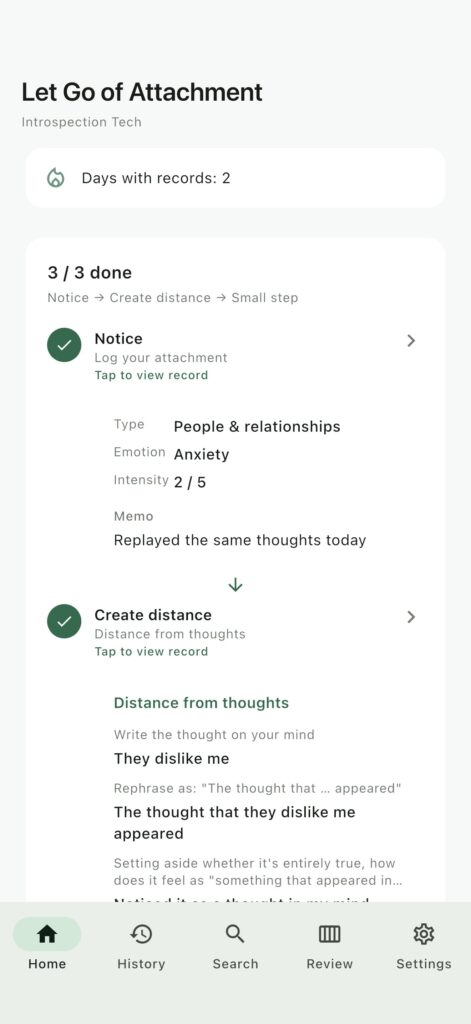
With an article alone, it’s easy to lose track of whether you practiced today. The app fixes that as one daily flow, with 3/3 complete and a streak count on the home screen.
Attachment types match the article’s six categories:
| Type | Examples |
|---|---|
| People & relationships | Replies, approval, distance |
| Things | Data, tools |
| Rightness & control | Perfectionism, “should be this way” |
| Thoughts | Rumination, anxious images |
| Past & future | Regret, worry ahead |
| Identity | “I have to be this kind of person” |
Features in the initial release
The first release (v1.0.0) includes:
2-1. Home — today’s three steps
- Tap “Start today’s steps” to move through notice → step back → a small step in order
- Close mid-flow and resume from the unfinished step
- After all three: “Today’s three steps are complete”
2-2. Attachment log (notice)
- Type (6 choices), emotion (presets + free text), intensity (1–5), optional note
- Records stay on your device only (no cloud sync)
2-3. Exercises (step back / a small step)
Step 2 is fixed to “Create distance from thoughts.” Step 3 rotates through the exercises below by day.
| Exercise | Step |
|---|---|
| Notice | 1 |
| Create distance from thoughts | 2 (fixed) |
| 30-second breathing | Supplementary |
| Values and a small action | 3 |
| One other perspective | 3 |
| Not today | 3 |
2-4. History, search, and review
| Tab | What it does |
|---|---|
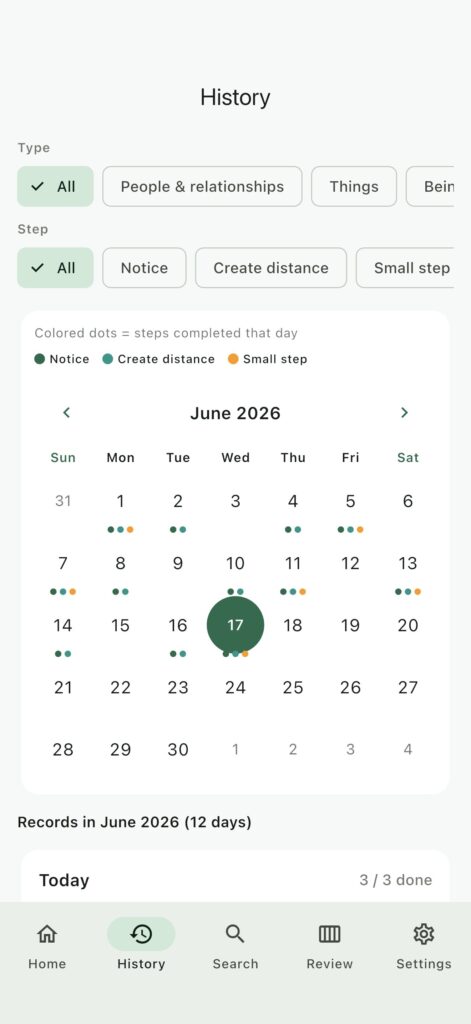
| History | Calendar view. Colored dots = steps completed that day. Filter by type and step |
| Search | Keyword search across past notes, emotions, and exercise answers |
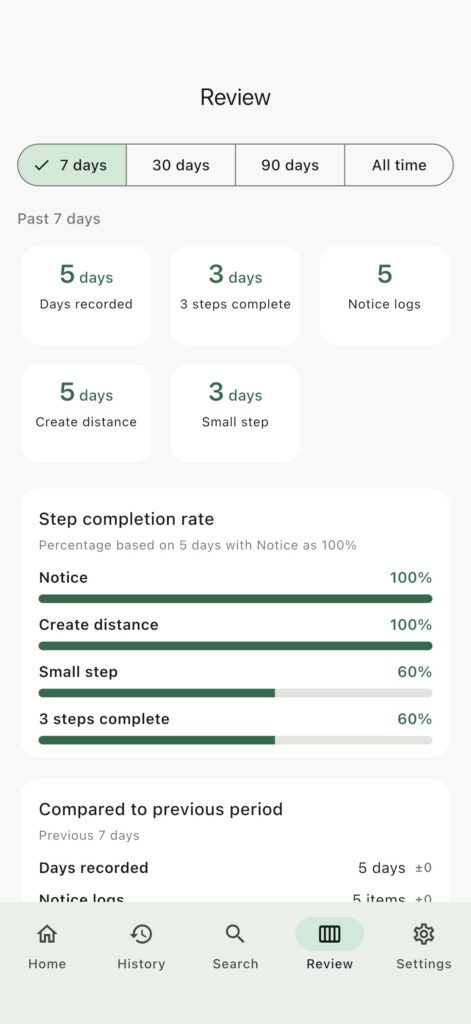
| Review | 7 / 30 / 90 days and all time. Days logged, step completion rate, intensity trends, comparison with the previous period |
The idea from the article — patterns emerge when you log over time — shows up on the review screen.
2-5. Settings and more
- Japanese / English
- One daily reminder (default 8:00 p.m.)
- First-run tutorial and disclaimer agreement
- Sample entries — demo scenarios that are not saved
3. Screen flow
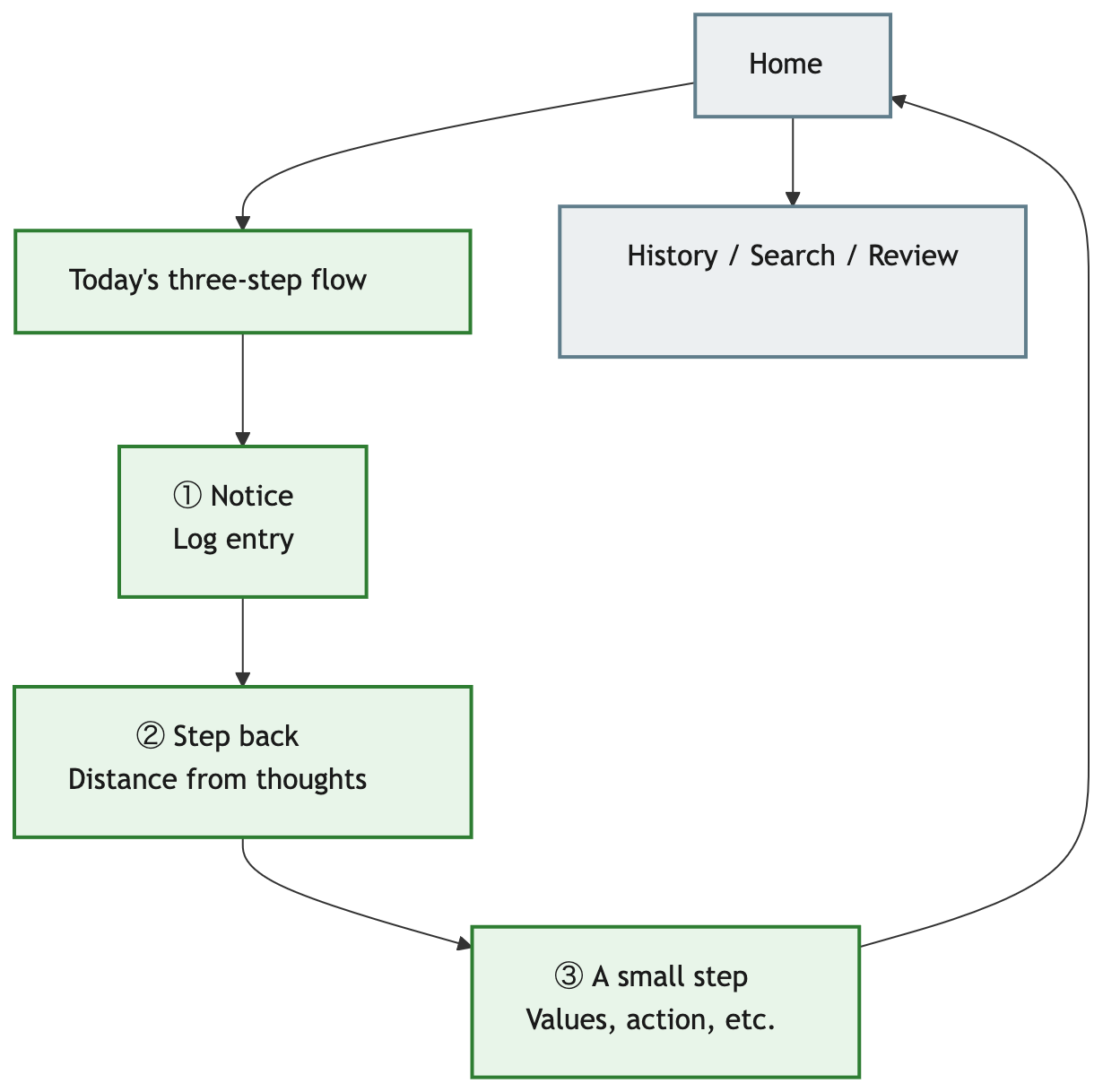
Green = in-app practice · Gray = tabs and settings
flowchart TB
  H["Home"]
  F["Today's three-step flow"]
  S1["① Notice<br/>Log entry"]
  S2["② Step back<br/>Distance from thoughts"]
  S3["③ A small step<br/>Values, action, etc."]
  T["History / Search / Review"]

  H --> F
  F --> S1 --> S2 --> S3 --> H
  H --> T

  classDef step fill:#e8f5e9,stroke:#2e7d32,stroke-width:2px,color:#1a1a1a
  classDef nav fill:#eceff1,stroke:#607d8b,stroke-width:2px,color:#1a1a1a
  class S1 step
  class S2 step
  class S3 step
  class H nav
  class F step
  class T nav
4. Download
| Store | Link |
|---|---|
| App Store (iOS) | Let Go of Attachment |
| Google Play (Android) | Let Go of Attachment |
Available in Japanese and English. All records stay on your device; nothing is sent to our servers.
| Screen | Store messaging |
|---|---|
| Home | Three steps complete · streak |
| History | Calendar and step colors |
| Search | Find past entries |
| Review | Completion rate and trends by period |
| Settings | Language · notifications · disclaimer |
5. What I learned building it
What worked
- Article → design → app kept the feature set focused
- One flow for three steps made “what to do today” clear
- Seeing your most common types in review connects back to the self-understanding part of the article
Still figuring out
- Streak display — balance between motivation and pressure
- Exercise rotation — only step 3 changes daily; preferences are still unknown
- My own usage log — I’ll keep notes as I use it in production
What I’d like to add later
- Five “hold vs. let go” questions
- Write and release (keep or discard text)
- Export records
- Fixed links to blog posts (previous article, etc.)
Where this fits in Introspection Tech
Introspection Tech is a series about learning a way of thinking and continuing it in an app.
| Content | Role |
|---|---|
| Attachment article (EN) | Why and how to work with attachment (theory and practice) |
| Let Go of Attachment (app) | Short daily practice loop |
| X copywriting agent (separate project) | Buddhist-themed posts — a different line under the brand |
It’s not article-only or tool-only. The set is read → try → log.
Summary
- I turned notice · step back · a small step from the previous post into a daily flow in “Let Go of Attachment”
- The initial release includes history, search, and review, and is on the App Store and Google Play
- It’s self-care practice, not a medical device — same disclaimer and tone as the article
A first step toward knowing your attachment patterns can be reading the post or logging once in the app. If you try it, I’d love to hear how it goes in a comment or on X.
Disclaimer
This app and article are for learning and self-care, not medical treatment. If depression, OCD, panic disorder, or similar conditions seriously affect daily life, please consider professional help rather than relying on self-help alone.

コメント