
Lead
Hi, I’m Pomarano.
This is Part 4 — the finale of my AI Agent Study Notes.
Series index Building Your Own AI Agents · Part 1 · Part 2 · Part 3
Part 1 covered concepts, Part 2 two-agent design, Part 3 with/without proofreading.
Here: series recap and practical tips for keeping agents running on a personal blog.
Code and specs live in pomarano/x_auto_writing. Use this as a map when you start your own small pipeline.
- Japanese version: 個人運用でエージェントを続けるために(第4回)*
Overview of this part
flowchart LR
  P1["Part 1<br/>Concepts"]
  P2["Part 2<br/>Design"]
  P3["Part 3<br/>Compare"]
  P4["Part 4<br/>Summary"]
  OPS["Production<br/>daily pipeline"]

  P1 --> P2 --> P3 --> P4 --> OPS

  classDef meta fill:#eceff1,stroke:#607d8b,stroke-width:2px,color:#1a1a1a
  classDef concept fill:#e8f4fc,stroke:#3d7ea6,stroke-width:2px,color:#1a1a1a
  classDef agent fill:#e8f5e9,stroke:#2e7d32,stroke-width:2px,color:#1a1a1a
  classDef output fill:#f3e5f5,stroke:#7b1fa2,stroke-width:2px,color:#1a1a1a
  class P1 concept
  class P2 concept
  class P3 agent
  class P4 meta
  class OPS output

Four blocks — recap
Throughout: semi-automatic Japanese X copy — agents write and proofread; humans review and post.
Replace JP links with English URLs after publish.
Three lessons from the series
2-1. Use chat and agents for different jobs
From Part 1: chat for ad-hoc advice; agents for fixed routines with spec.
| Use case | Tool |
|---|---|
| Outline help, brainstorming | Chat |
| Same morning X draft + same checks | Agent |
Do not agent-ify everything — put repeating patterns on agents.
2-2. Rules in spec; verification in another layer
“140 chars max” in spec still failed 5/5 runs in Condition A (Part 3).
Same as the harness article: polite requests alone are unstable.
| Layer | Role | Example files |
|---|---|---|
| spec | Source of truth | x-shuuchaku-agent-spec.md / x-proofread-agent-spec.md |
| prompt | “Run today’s job per spec” | automation/x-daily/prompt.md |
| Proofread (verify) | Check and fix output | Proofreading agent |
Change spec only; keep prompts thin — consistent since Part 2.
2-3. Two agents make results measurable
Copy-only mixes writing skill, rule following, and model quirks.
Splitting copy and proofread enables A/B comparison (Part 3).
| Metric | Copy only | Copy + proofread |
|---|---|---|
| Checklist pass | 40% | 93% |
| Human edits | ~8 min | ~2 min |
| Post as-is | 0 / 5 | 4 / 5 |
Proofreading does not replace humans for theme duplication or teaching accuracy.
Practical tips for adoption
3-1. Start small and measure
| Tip | Detail |
|---|---|
| One agent OK; verify separately | Copy alone works; measure compliance via proofread or harness |
| Spec is canonical | Rule changes → spec only |
| Prefer semi-auto | Reviewable beats fully automatic for individuals |
| Compare with numbers | A/B, pass rate, edit minutes |
3-2. When to split into multiple agents
Consider two or more when:
- One prompt mixes “write” and “fix” and quality wobbles
- Six+ check items and you edit by hand every time
- You need to know which role failed
Copy + proofread enabled Part 3’s comparison.
3-3. Stumbles and fixes
| Stumble | Fix |
|---|---|
| Length / format keeps failing | Proofreading agent or harness |
| Wrong or inappropriate content | Human final review |
| Manual start is tedious | GitHub Actions (X semi-auto) |
| Spec drift | One line in spec per week |
| Too many agents too soon | Stabilize one pipeline first |
Production — daily pipeline
Run the two agents from the study notes every day.
flowchart TB
  T["Morning (fixed time)"]
  A1["① Copy agent<br/>research · draft"]
  A2["② Save draft md"]
  A3["③ Proofread agent<br/>6-item check"]
  H1["④ Human review"]
  H2{⑤ Edit?}
  H3["⑥ Post to X"]
  H4["⑦ status: posted (optional)"]

  T --> A1 --> A2 --> A3 --> H1 --> H2
  H2 -->|if needed| H1
  H2 -->|OK| H3 --> H4

  classDef agent fill:#e8f5e9,stroke:#2e7d32,stroke-width:2px,color:#1a1a1a
  classDef human fill:#fff3e0,stroke:#e65100,stroke-width:2px,color:#1a1a1a
  class A1 agent
  class A2 agent
  class A3 agent
  class H1 human
  class H2 human
  class H3 human
  class H4 human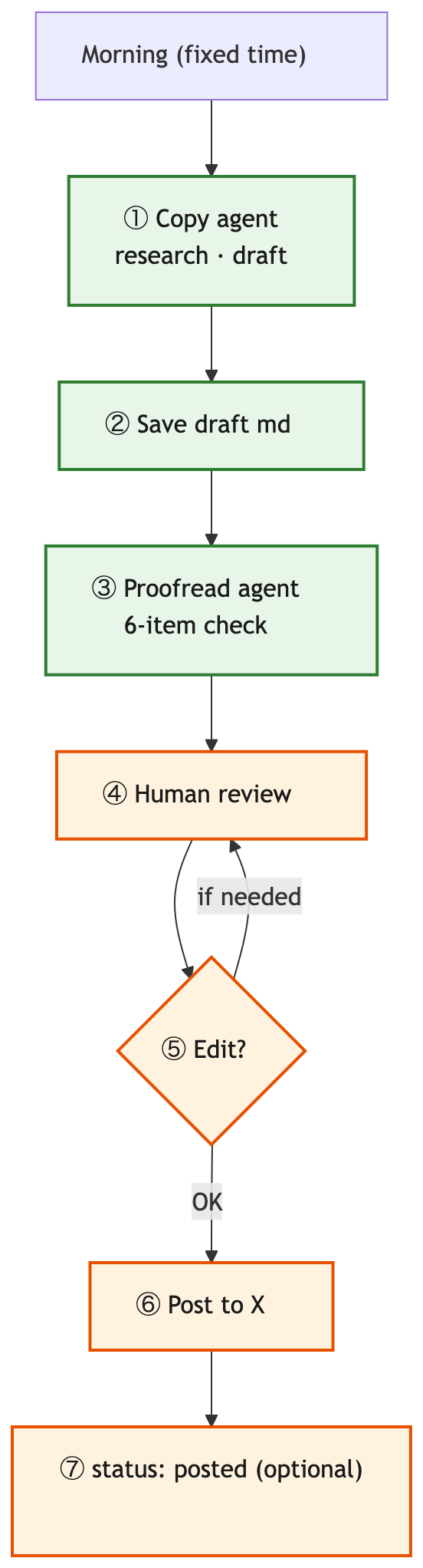
| Stage | Owner | Work |
|---|---|---|
| Copy | Copy agent | One post per weekday rotation |
| Proofread | Proofread agent | 140 chars, two-sentence shape, etc. |
| Review | Human | Email or GitHub → post |
| Log | Human (optional) | status: posted |
Automating copy with GitHub Actions + Cursor SDK still leaves proofread and posting to humans — same design as Part 2.
Minimum starter kit (any theme)
| Step | Action |
|---|---|
| 1 | One-sentence goal — e.g. “Save one X draft md every morning” |
| 2 | Write spec — format, bans, out-of-scope |
| 3 | Thin prompt — “Run today’s job per spec” |
| 4 | Five manual runs — note failure patterns |
| 5 | Add verification — proofread agent or harness |
| 6 | A/B measure — until numbers improve |
| 7 | Actions if needed — after ops feel stable |
Template repo: pomarano/x_auto_writing
Next steps for a personal blog
| Priority | Action |
|---|---|
| High | Daily rhythm — copy → proofread → human → X |
| High | From proofread logs, add top violations to copy spec |
| Medium | Actions for copy; proofread manual or chained |
| Low | Second pipeline (blog drafts, etc.) — same pattern |
Relaunching the blog to record AI learning means agent ops are both subject and material.
Stabilize one pipeline before multiplying agents.
Related posts
| Post | Content |
|---|---|
| Index — AI Agent Study (JP) | Reading order |
| Part 1 (JP) | Concepts |
| Part 2 (JP) | Design |
| Part 3 (JP) | Metrics |
| Harness (EN) | JSON verification |
| X semi-auto (EN) | Actions · email |
Summary
- Generative AI for consultation; agents for fixed routines
- spec + prompt + proofread brings rule compliance to a practical level
- Copy + proofread: pass rate 40% → 93%, edits ~8 min → ~2 min (Part 3)
- Sustain with semi-auto, spec as truth, measurable comparison
- Study notes end here; daily two-agent ops is production
From Part 1‘s goal of putting AI on routines, through design, build, and compare — the arc is complete.
Try building just one small agent pipeline of your own.

コメント